Week 3 – Day 1 – MYOB

Week 3 was incredibly intense as the production for our products needed to be underway. All of our materials were ordered off of amazon prime, however, when they arrived they were not the correct thickness…. which was a big problem. At first we were incredibly stressed as this was something which we didn’t want to happen, however after speaking with Maggie (the textiles tech dem) we came up with a few ideas which we could experiment with to try and solve the problem.


Material arrival:


Material images

Maggie suggested using bonder webbing to attach the pleather to the felt to increase the hardness and durability of the pleather we were using. As an interior design student I have not got much knowledge in textile based activities; however, I was incredibly interested to learn and expand my knowledge within this field. In order to attach the felt to the pleather we heated the bonder webbing by using an iron to press the materials together. I learned that as the bonder webbing is heated the material makes a sort of gluey substance which allows the 2 different materials to stick together… creating a very strong bond. Learning that this process was possible enabled us to use the materials we had ordered and not put them to waste. In addition to bonding the materials we started to digitally stitch our logo onto our workwear; again I have not done this before and was interested in how the process works. Harleigh and Daria are textile and fashion design students and are trained to use the stitch machines; due to their experience with digital stitch  they were able to efficiently tell me how the process works and allowed me to be involved within the making of the logos. Each logo was stitched with a different colour to represent all of the individuals within the company and their personality. (The colour which I had chosen as my colour was bright pink)  By the end of the day all 6 t-shirts had been digitally stitched with our logo on them ready for sales day and our presentation.


DIGITALLY STITCHED LOGO:


digital stitch

Alongside sorting out the materials Aidan (our Graphic Designer) had been to the print studio and got our finalised business cards printed. To enhance the aesthetic of the business card he also created some black card holders which wrap around the business card – these will be laser cut with our strapline “it’s a cover up” on them to provide an edgy and stylish look. Tuesday was a very busy day for everyone in our group; one of the other tasks we did that day was to print our graphic posters advertising our company and then put them up around the whole university. The posters which we decided to use were the ones which I had created- the pattern I used for the background of the poster was created by Aidan (we all agreed that this paint brush design perfectly suited our brand) which provided a contemporary and attractive look to our posters and made them interesting and intriguing. I placed the posters around the majority of the university blocks and ensured that they were put in places where people can easily see and read them- this is incredibly important to ensure that the posters are legible.


BUSINESS CARDS:


Buisness card Back of buisness card


CONSILIO POSTERS:


CONSILIO- poster x2     CONSILIO- posters

consilio poster


WEEK 2 – MYOB – feedback and development

PROJECT DEVELOPMENT:


On Thursday we presented our final idea to the other groups within the MYOB project, this enabled us to obtain feedback about our designs and if there was anything we could do to enhance our companies advertisement or final product design. The feedback we were given was incredibly beneficial, one main point which we were given was that at first glance our logo looked like a company of whom produced makeup products. This was due to the fact that we had used a brush effect on logo. We then discussed how we could change the logo to make it more appropriate to our bespoke laptop sleeve business. Aiden our graphic designer came up with a contemporary piece of abstract art; incorporating the brush strokes to make our logo stand out but not look like a makeup brand.


BEFORE FEEDBACK:


First laptop sleeve


AFTER FEEDBACK:


business card


Another piece of feedback that we obtained was to consider producing an attachment for your laptop charger. This was something we had been considering since the start but we prevented by not having a large enough budget. We considered using the scrap felt which we had obtained for free from the textiles studio but were unsure if this would provide the casing with enough protection. Over the weekend and during next week we will be experimenting with materials to see if they will be suitable enough for our laptop sleeves. During last terms field project (Interior Styling) there was an abundance of different materials which were left over from the donations they received. We used this opportunity to ask if we could use some of the left over material and we were given permission to use them. This enabled us to create a mock up of our laptop sleeve design using left over felt, thus allowing us to gain a better understanding of how we should attach the materials together to create the perfect laptop case. Although the felt was not thick enough it provided us with a rough idea of the layout we want to produce for our final design. In order to ensure that we start the making process as soon as possible I ordered samples of potential pleather fabric which we will be using for the laptop sleeves. I ordered them off of amazon prime which meant that they would come asap to give us enough time to discuss whether the material is suitable for the production of our product.

Alongside creating mock ups of our products we also discussed how we wanted to display our products on the sales event. As an interior design student I decided to use my skills on SketchUp to design a potential object display set up. As we only have a budget of £100 we needed to make sure that the display space was produced at a very little cost; I decided to have a look around charity shops and car boot sales for cheap stands which could potentially be used. I have still not found anything which will be suitable but I intend to continue looking for suitable stands which will be appropriate for the display of our laptop sleeves.


MOCK UP LAPTOP SLEEVES:


mock up laptop sleeves

mock up laptop sleeve x2


Week 2 – MYOB – Elevator Pitch

ELEVATOR PITCH:


As part of our MYOB project each group had to complete an elevator pitch. This term was something I had never heard before however, after Richard explained what occurred within the elevator pitch I understood its importance. In order to pitch your business effectively and efficiently to an employer you need to be sharp, accurate and precise in the description of your business. Being clear, unambiguous and direct is incredibly important to ensure that the businesses motives and goals are correctly understood.

The elevator pitch would last approximately 17.8 seconds; this was the amount of time it took to go from the ground floor to the third floor in the CSAD building. At first I didn’t think that their would be enough time to successfully describe our business however, after practising the pitch I realised that it was more than enough time to provide a direct and crisp description of our company. As a team we collectively decided that only one person should do the speaking within the elevator pitch; reducing the possibility of multiple mistakes made. I volunteered to speak as I have completed pitches in previous projects as part of my interior design assessments.  In the days leading up to the elevator pitch we discussed how we would best describe our business, ensuring that we included who are target market is, our values and of course the product we will be designing, producing and marketing.

Elevator pitch


Our finalised pitch can be seen below:


“WHO THE HELL ARE WE!”- Said by Harleigh

“Consilio, a company that creates bespoke laptop sleeves – ‘IT’S A COVER UP’ We pride ourselves by giving you the freedom to be YOU, with our quirky, extrovert designs.” – Said by Me

“MADE FOR YOU THE STUDENT” – Said by Me

Aiden hands Richard our Mock Up business card.

Harleigh hands Richard our badge and says “Wear it with pride” ( as the doors of the elevator opened”

BUISNESS CARD:

business card


 FEEDBACK:


The elevator pitch went really well and we managed to complete it within 16 seconds and also had enough time to give Richard our business card which had details of our contact details and social media pages. The feedback we got from this pitch was incredibly good and Richard said that our use of splitting up the pitch was very successful. We decided that another person within our group should start the pitch by asking the question “who the hell are we?” thus ,causing an unexpected turn in the pitch rather than the whole pitch being dictated by myself. This provided the pitch with additional elevation making it more interesting and rememberable.


Presentation:


On Tuesday 21st we had a presentation on how to make a successful business canvas model. I had never heard of this model before and was intrigued as to what it depicted. Presentations like these are essential as they can provide me with skills which I could potentially require for future projects or if I create my own business in my future career.

The Business Canvas Model is a model that helps people understand the different areas within you business. These can include key partners (The people or companies that your company is working with or alongside) or Key activities which makes your company professional e.g. Quality control of products and manufacture. I learned that these models are useful to differentiate the different processes which take place within the business and enables you to allocate specific traits of that activity; thus making it easier to produce a business plan.

Buisness canvas model


DAY 2- myob- field term 2


As a creative collective team we had been discussing and sharing our initial ideas over our group chat following our first meeting of the mind your own business course. We discussed our client personas in order to obtain a better understanding of who we would be designing, producing and marketing our products too. Collectively we decided that our products would be aimed at students in particular therefore, we need to ensure that our  laptop sleeves are on trend, stylish, unique and of a high standard and quality.

Once we had decided on our ideal target market/clientele we started to  individually create personal persona’s which would perfectly depict the client we are marketing our products too. It was incredibly interesting to see peoples interpretations of how they would best describe a student; although the majority of our ideas were similar there were a few sections which were slightly different. Although we came across these differences we decided to include them within the final client persona profile as we realised that no one student is the same. Alongside creating individual personas we also decided to each create 2 mood boards which described the theme which we believed best suited our target market. Again this was incredibly interesting as we all created a variety of different mood boards which depicted a variety of different themes and styles. We then discussed the possibility of combining the different ideas into our designs. For example, I decided to use quite neutral and greyish tones within my mood board whereas both Harleigh and Daria used bright neon and bold colours. Therefore, in order to compromise we agreed that using a combination of grey neutral colours and contrasting them with bright bold patterns would produce a stylish and aesthetically pleasing laptop sleeve.

Next on the agenda for our group was to come up with a brand name! Initially we were  incredibly quiet whilst we thought of potential ideas. To help us understand the importance of brand names and straplines Richard our lecturer informed us that our brand name must be catchy, simple and efficiently explain what you are selling. We then started to throw out a few ideas including:

  • Hip Design
  • Luxsit
  • Infocus
  • BrighterBee
  • Progresso
  • Consilio ( This means “Design” In Latin)

Initially we really like the name Infocus as we believed that it linked well with our values as a group; implying that we are passionate, motivated and focused on producing high quality products. As a brand name this was quite catchy and interesting however, we were still incredibly unsure on whether it was suitable for the final brand name. We then looked into the name Consilio – I personally liked this name a lot and I believed that it had a nice ring to it and was incredibly stylish and unique. Instead of finalising our brand name we decided to design a few different logos with the different names we had suggested. This then allowed us to effectively chose a brand name which perfectly suited our aims and products.


OUR MYOB GROUP CHAT :

This shows a few inital ideas that we had come up with for potential logos and names.


Myob group chat

DAY 1 – Mind Your Own Business

Meeting my MYOB team:


I was incredibly excited to start my term 2 field project and was looking forward to meeting and working with individuals from different disciplines. During the first 30 minutes of the session I met my business “family” and was introduced to the aim of the field project.

The brief for this project is to design, make, brand and market a product as a creative collective team. Each group will be given £100 as a ‘seed’ fund which will help enable the business module to successfully take place. As part of the project we had to elect someone within the group to become the financial adviser and take care of the amount of money we spend on materials. I was chosen to do this as I have experience in handling money; as well as being able to efficiently use Word excel to document the amount we spend on materials and our overall profit. One we had elected roles to each member of the creative team we were advised to come up with 5 different values which defined us as a team and what we expect each member to abide by throughout this project.

Work


Our Agreed Creative Collective Values:


  1. Accountability– Each team member must pull their own weight within the project and be responsible for downfalls which may be caused by their inability to commit to the project.
  2. Diversity – We want our product to be universal and for their to be something for everyone; both male and female and for a variety of different age generations.
  3. Passion– Each team member needs to be motivated, passionate and committed to the project in order for us to succesfully produce a good quality product.
  4. Teamwork– In order for our creative collective team to work efficently and successfully throughout this project we need to be gelled and respect each individuals ideas.
  5. Creativity – As a team we will design a selection of products which are aesthetically pleasing, unique, stylish and on trend.

KEY TERMINOLOGY: 

I have never completed a business course before and therefore, the lectures taught me some new terminology. As an interior design student and an A level Product design student I knew how to design products or spaces which are perfectly suited to the needs and requirements of the target market/cliental. However, I learned about the different marketing methods which are used when designing and selling a product for certain target markets.

Mass Marketing– (undifferentiated) = business target the WHOLE market. In order to succeed and sell vast quantities of their products their designs are tailored to what customers need, require and WANT!!!!!

Segmented Marketing- (differentiated) = target several market segments within the same market. This means that the consumers are segmented into different groups which they have common interests with.

Concentrated- (niche) – Business focus narrowly on smaller segments. This includes companies such as Oatley and Holland and Barrett.


PROJECT DISCUSSIONS:

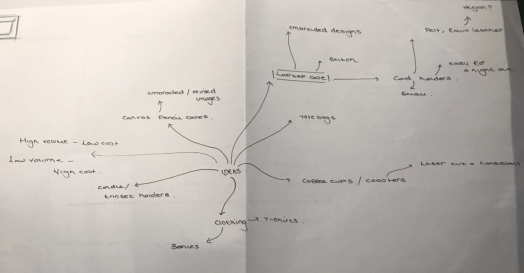
I have always believed that the key to successful projects is hard work and my team members thought the same. Therefore, in order to start the project off well we decided to create a mind map of different ideas which we could possibly develop further. We then discussed what we would buy if the roles reversed and we were potentially buying a product. After a long discussion we collectively decided to design and make laptop sleeves for uni students and lectures. This is because a large proportion of students have laptops and ipads for their courses and we believed that individuals would buy a unique sleeve. To communicate with each other we created a Facebook group chat where we can share our ideas and designs we have created when we have not been into uni. This allows us to constantly be connected.

mind map

Field Evaluation

Level 5, term 2 field was incredibly interesting, and I thoroughly enjoyed learning about sites spaces and public places. I believe that this topic has benefited me and has shown me a variety of different skills and interesting site-specific and public artists which will be perfect to research into for my future interior design projects. Throughout the weeks I gained new skills and knowledge, particularly with understanding how art in public places is a way to increase the community’s social cohesion as well as their ownership of the space. I have benefited greatly from this field project compared to field in level 4 as the topic relates to my discipline subject massively. One thing which I found really helpful was having tutorials in groups as it enabled me to obtain feedback from not only my project lecturer but also from fellow students who might be able to provide feedback or ideas which I hadn’t thought of before. I have really enjoyed working I have always been interested in how peoples behavioural and emotional responses change depending on the space they are surrounded by and therefore, understanding a variety of mixed opinions about spaces and how they make different people feel has inspired me further within my course subject. One thing which I was interested in was the different ways in which the public can react to the construction/creation of art installations.

My course leader for interior design; Craig Thomas carried out a lecture where he spoke about the impact of Richard Serra’s “tilted arc” sculpture on the public realm. I was incredibly shocked to learn that an intense public debate leads to the removal of the famous steel sculpture. Although the government had asked Serra to produce a piece of artwork for the plaza, they refused to accept that his work provided a positive impact to space and stating that it was ugly and interfered with the social cohesion of the space as it sectioned off the plaza into halves. As a group, we discussed this topic intensely and it sparked a debate as to whether the removal of the “tilted arc” was necessary or not. I believe that the placing of the arc would have attracted more attention to space and therefore, encourage social cohesion to occur more often as people are more likely to share their opinion of the sculpture. Whereas, others in the group suggested that it was an ugly piece of artwork which distracted people from the beauty of the buildings that it was surrounded by. It was interesting working alongside different people from a variety of disciplines and understand their thoughts and feelings where towards different topics.

As an interior design student, I believe that this field topic will help me in the future when designing interiors or installations and how to go about placing artwork within the public realm. A massive part of this topic was the ability for designers to work together when producing artwork in the public realm. Outsourcing was a sub-topic which showed me that by working with a variety of different people with different skills and mindsets helps you to produce a piece of work which is often bigger and better than what you would produce alone. This is because the more people you collaborate with the wider variety of ideas you will obtain, thus, ensuring the production of a diverse, unique and exciting piece of artwork. As part of this project, we had to find a public space and create a piece of artwork which would make a difference to the area. I chose to regenerate an underpass which I use regularly to and from the university and the city centre. The reason I chose to use underpasses as my focal point of this project was that I find them incredibly scary, unsafe and ugly. Therefore, I thought this was the perfect opportunity to redesign a space which is used a lot by the public. Although this project was hypothetical I will continue to peruse this design as I believe it is incredibly important to increase the safety of underpasses and reduce their place lessness.

FINAL DESIGN FOR FIELD PROJECT:

At the start of my field project my brain was full of ideas and concepts that I wanted to experiment with for this design brief. After thinking long and hard about all the possibilities available I decided to go with a design which was incredibly personal to me. Underpasses were designed and built in order to create easy and quick access to different sections of cities without the need to wait for the traffic to stop on the road to let you pass. In many ways these are a genius invention as they help reduce pedestrian road traffic accidents and allow individuals to get to and from places in a quick and efficient manner. However, on the other hand these places can be scary, potentially dangerous and incredibly ugly. Most underpasses are the same in every city around the world; they only serve to facilitate one main function which is allowing pedestrians to cross roads quickly. The design of underpasses is ugly and often get defaced by graffiti, which further degrades the aesthetic of the space. This graffiti is a way of the community making their mark on the space and trying to make a boring space increasingly more interesting.


underpass       Pedestrian-Underpass1.jpg


Therefore, my aim is to encourage the community to feel connected to the city by increasing the safety and aesthetic appearance of the spaces which connects the city together. I decided to create a name for this project as I thought it was important to give my design a purpose; I chose to call this design “Cardiff’s connecting colours”. The city of Cardiff is connected via a variety of different underpasses and I thought it would be incredibly fun to increase the aesthetic appearance and purpose of these forgotten and abandoned spaces. In the future I would like to expand this project and collaborate with a variety of different designers to improve the underpasses and design a different aesthetic appearance to each of them. Collaborating with different artists and designers will enable each space to be unique in their own way and portray something different.
As an interior design student, I decided to portray my ideas using SketchUp, photoshop and by producing a sketch model. I thoroughly enjoyed working on SketchUp for this project as I was using bright and bold colours which inevitably created a fun and interesting space. At the start of the design I found it hard to obtain the right lighting for the space, which was incredibly frustrating. However, once I rectified this problem both SketchUp and V-ray rendering worked smoothly. Once I had obtained the visuals, I wanted I used photoshop to add details which would make the design look like it was within the space. This was very fun and allowed me to see what my design would look like when placed in the selected space.


sketchup image .png       photoshop image .png


One thing which I wanted to try and formulate within this project was the use of car energy on the road to stimulate the lights in the underpass. After completing some research into this technique, I came across a website which describes the use of speed bumps which generate energy to power street lights. “A conventional speed bump wastes a huge amount of energy when a car is forced to bring itself from a higher, more efficient cruising speed to almost zero. Large cities have a high number of speed bumps – and an equally high level of traffic.” (Rauneek, n.d.) Therefore, storing this energy and using it to generate light energy for the underpasses light installations will be incredibly sustainable.


Bibliography
Rauneek. (n.d.). Bright Hub Engineering . Retrieved from Energy from speed bumps : https://www.brighthubengineering.com/hvac/32750-a-new-way-for-generating-energy-speed-bumps/

photoshop image .png

How art in the public realm can affect the community?


This terms field has educated me on a variety of different skills which will be essential in my future career within the design world. I learned how art in the public realm affects the community, this was very interesting as it showed me a variety of different ways that art and design can both help and hinder the community and environment. Art often stimulates debates, this is because sometimes artists want their audiences to carefully think about the meaning of the artwork and what it portrays. This simulates a variety of different conversations as people opinions can often be completely opposing; although this is a bad thing it also shows an element of social cohesion within the community. Alongside this, the development of art within the public realm can empower people by handing back authority, creativity and ownership to the community. This can be done by collaborating with the community to create a piece of artwork or design which is special and important to them and resembles the community’s morals and personalities. Artwork can bring people together and can allow the community to feel safe and stronger.

This is what I want to achieve with my light installation in the ‘Boulevard de Nantes’ underpass, I want to bring the community together and connecting sections of the city in a safer way. The lights will help guide pedestrians through the underpasses to the other side, it will be an intriguing, exciting and interesting experience; therefore, enabling underpasses to be a welcoming and fun space rather than a scary, dark and damp environment. The artwork within the public realm can help to captivate people’s imaginations and encourage creativity within the community; murals, sculptures and installations can change a space’s characteristics and personality which inevitably allows individuals to express their own thoughts and feelings in relation to the artwork. Thereby opening their minds to the possibilities available in the art world.


art in the public realm.jpg

Independent Intervention – CSAD

As part of the Intervention lecture Antre set up, we had to create our intervention on the CSAD. I am not a very confident person when it comes to performances or things which would draw attention to me; therefore, this pushed me out of comfort zone hugely. I found it incredibly hard to think of something which would create an intervention. After coming up with a variety of different ideas I decided to sit down in different locations outside of the CSAD building and observe what people do within those specific areas. I used a linen cloth I found in the interior design studio and sat on it, at first I felt very uncomfortable and out of place; however, as time went on I realised that not many people took notice of me and didn’t find it strange that I was sat on the floor on a wet day watching everyone. What I found out from this intervention was that I was able to feel more comfortable and at peace when I was facing the greenery and woodland behind the university building. This space allowed me to concentrate on my thoughts and emotions and enabled me to take in the beauty of the environment that surrounded me. Unlike this tranquil and peaceful experience sitting on the concrete floor surrounded by large brick buildings made me lose focus and concentration of my thoughts as I was preoccupied on watching what other people were doing and what they were talking about. One thing I noticed was the number of people who were smoking, they used it as an area to socialise with other smokers. Although this showed me an element of cohesion within the student community it also showed me how little respect students have on the surrounding environment. Many of the smokers dropped their cigarettes on the floor or on top of bins which destroyed the natural aesthetic of the space. Observing from different angles of the space made me realise how natural and constructed spaces can make you feel different emotions and make you behave differently. I found that those who were surrounded by the woodland were more focused on their work and therefore is a place to reflect, compose thoughts and observe the natural environment. However, those who were in the constructed space socialised more had more things to distract them and rarely had the opportunity to compose their thoughts.
I found this intervention a great way to understand how people behave in certain environments and also allowed me to realise how I respond to being in different spaces both natural and industrial.


field - work                                field work 2.png


field work 3.png                               field work 4.png


Intervention, Engagement and Disruption

Andre Stitt held a lecture on “Intervention, Engagement and Disruption”, I found this incredibly interesting as there were some cases which inspired me for my final project for the field. One thing which I found interesting is understanding how CCTV cameras affect the way individuals behave when in an environment. CCTV cameras are used as a security method to catch an indecent or dangerous behaviour from the public, they are used in shops, streets and large venues to ensure the safety of the rest of the general public whilst they are in that space. Behaviour within different spaces can change depending on the atmosphere within the place, however, if individuals know they are being watched will they think carefully about what they do or say whilst in public places? In places which are dark and scary such as underpasses will the appearance of CCTV cameras help to prevent dangerous or suspicious behaviour therefore, enabling them to be safer for pedestrians? Throughout my research for my final project, I was disappointed not to find any security cameras on in the “Boulevard de Nantes” underpass. As a student I feel incredibly vulnerable when walking through underpasses; especially at night therefore, the fact that the place does not have any CCTV cameras is quite daunting. As part of my study, I want to place security cameras on each end of the underpass in the hope to increase the safety of the area and ensure that people’s behaviour is more acceptable to society’s public etiquette. In November 1996 The Surveillance Camera Players were formed. These are cameras which capture videos of activity within public places- Therefore, if you are caught on camera doing something you shouldn’t be doing then you can be charged as guilty. Some people believe that these cameras are invading the public places however, I personally believe that surveillance cameras can help with many things and help solve crimes.


CCTV CAMERA:


CCTV camera
One thing which I have noticed since moving to Cardiff is the amount of Homelessness which can be seen. Public places are the only spaces where homeless individuals can sleep, therefore, public spaces such as streets and underpasses are often used as recreational sleeping shelters for people of whom are unable to get off the streets. Andre’s lecture showed me that Krzysztof Wodiczko created a homeless vehicle in 1987-8, this was done in order to draw attention to homelessness within the area. This was a good way to reduce the number of homeless people who took shelter in underpasses and ensured that they had somewhere portable, dry and comfortable to sleep and eat. I found that when I investigated the underpass “Boulevard de Nantes” there were several homeless people using it as a shelter, initially I felt sorry for them as it was hard to see, however, as I walked past they were constantly begging for money which made me feel incredibly uncomfortable and vulnerable as I had no money to give them. Walking alone In the dark through these public places can be scary especially with limited light I also believe that eliminating the ability for homeless people to sleep in them can increase the safety of the spaces.


Below shows an image of Krzysztof Wodiczko’s homless vehicle used on the streets of New York City


Homeless picturehttp://www.biennial.com/2016/exhibition/artists/krzysztof-wodiczko


Design a site like this with WordPress.com
Get started