END OF YEAR EVALUATION – EXPOSURE

This year has been crazy!!!!


Not only have I experienced a global pandemic, but I have had to adapt to a new style of learning like all students around the world, which at times was frustrating, overwhelming and un-motivational. At first, It did not quite sink in that my 3rd and final year of uni would be online and face to face teaching would permanently stop. Learning from home was a strange experience and to be honest not something I enjoyed at all. I have always found that I am a creative hands-on learner and therefore, the inability to access the studio and other university facilities including the library; especially when I was completing my dissertation was hard and disappointing. Whilst the normal uni life and education was on hold I have shown myself that regardless of the challenges I face, whether personal or work-related I can always overcome them.


The word ‘Dissertation’ was what I feared most about uni. Although we were given weekly constellation sessions over the 3 years to help enable us to write critically, nothing can prepare you for writing 10,000 words with minimal guidance and help. Since I can remember I have always been fascinated with a place or spaces ability to change the way we feel and behave, thereby it was the perfect thesis question. It was something I enjoyed reading about and therefore, although it was a scary process it was surprisingly easy to write about. My independent research led me to gain a fascination with the design of institutional spaces, in particular Jeremey Bentham’s Panopticon concept. I never knew that I would have an interest in prison, hospital and school design but my thesis has brought out a passion I never knew I had. I have learnt so much about myself during this section of my final year including my ability to write a high-quality piece of critical literature that is both impressive and engaging.

Both my Perform and Exposure projects were incredibly successful and, in my opinion, the best work I have ever produced. Unlike previous years, both these projects have been designed with a personal connection behind them. My perform project ‘AIDA’ allowed me to express my fun side, the bold bright tones and textures overwhelmed the space but it perfectly complimented the opera performance for which it was made for. The use of container ships for this project was incredibly interesting and allowed for a significant amount of freedom with the spatial design of the site. Exposure was the first project where I had to personally find the perfect host building for the space I intended to create. The space I chose was a building that was in my hometown of Dorchester, Dorset. As I knew the area incredibly well it allowed me to understand the strengths and weaknesses of starting a business there and enabled me to produce a solid host building and site analysis. I believe I have fully engaged, attended and committed to both my dissertation and final year projects and strongly believe that completing them during a pandemic has shown me that I can produce high-quality work under pressure.

During my final year we were given a project called ‘Professional practice’. This project involved the compilation of my cv, covering letter, live applications and my exist strategy for leaving uni. I found this part of the project very hard as I am still unsure which avenue I want to go down and therefore I struggled to write an exist strategy. I believe that once I leave Uni I will take some time to experience the world and what it has to offer alongside obtaining a variety of work experience in the interior design field.


This is the end of my life as an interior design student, but it is the start of my career within the design world, and I am incredibly excited to see what the future holds for me. The 3 years I have been at Cardiff Met has made me a confident, talented and hard-working individual and has developed me into a unique interior designer.

END OF PROJECT EVALUATION:

CJ’S:

IN LOVING MEMORY OF COLIN DAVIES (Gramps)

My final ever interior design project for my degree at Cardiff Metropolitan University has been filled with highs and lows. It has challenged me as a designer in ways that will only help me enhance the quality of my work and design projects in the future. Losing my Gramps during my final year of Uni was my incentive for this project, and whilst it had the potential to be an incredibly emotional process, I found it incredibly therapeutic and rewarding. Therefore, alongside my Perform project which took place earlier on in the year, I believe that this has been one of my most successful projects.


As a child, I was shown images of the original CJ’s and often referred to them as relics due to their grainy, black and white appearance. However, speaking to my grandparents about CJ’s allowed me to gain a better understanding of the atmosphere and mood of the space. Not knowing everything about the space allowed my project to be open to my interpretation of the space and therefore, I was able to create a space that not only incorporates the original aesthetic but also satisfy modern societal needs and requirements. During the design process, I believe I successfully captured the aesthetic required for CJ’s Restaurant, Wine bar and Deli to function to their best ability. My use of colour, texture, tone and form incorporated a combination of minimalistic materials such as wood, stone and metal whilst contrasting with the maximalist use of the original Sanderson wallpaper. Whilst some people may find the overuse of wallpaper overwhelming, I believe it tells a story and brings the old restaurant aesthetic to life. Although the design of my chosen spaces was progressing nicely, I was concerned about using the software AUTOCAD as I had never used it before and was told it was a requirement for 3rd-year submissions. I spent several weeks getting to grips with the software and initially became incredibly frustrated as I could not see myself progressing to the high standard required. However, week 3 of using AUTOCAD was a breakthrough and I managed to push aside any fears and frustration I had towards the software and trusted the process. During this time, I managed to produce several high-quality scaled plans, sections and elevations which have shown me that if I just believe in myself and trust the process, I can overcome any challenges I am faced with as a designer.

My 3rd and final year of Uni, unfortunately, occurred during a global pandemic which complicated and changed the way lectures took place. Although my learning experience and face to face lectures were compromised, I believe I continued to attend, engage and fully commit to the lectures which were set online. Consequently, trying to maintain my levels of motivation was incredibly tough and at points, I could not see the point in what I was doing or trying to achieve. Although I went through periods where I lost motivation, I believe that this has enabled me to rediscover my love and voice within interior design and why I decided to do this course in the first place. I believe I have managed to successfully reach my potential during a very stressful and scary time of our lives.


I hope that this is just the start of my career within interior design and can’t wait to further my knowledge and understanding of the design world during my future endeavours.

CJ’s Restaurant
CJ’s Wine Bar
CJ’s Wine Bar
CJ’s Takeaway Deli

COMMUNICATION REVIEW:


The communication review is a great way for my lecturers to see how far I have developed my project over the past couple of weeks. Since my first year at university the level of detail within my SketchUp models has significantly increased and consequently so has the quality of my conceptual visuals. I have seen a dramatic improvement in the quality of my work especially with this particular project and believe that my knowledge and understanding of interior design, sustainability and contemporary and vintage art has progressively developed.

During this project, I have been very conscious of the overall level of sustainability that the business accomplishes. To ensure that the business is as sustainable as possible I have ensured that the products used within the restaurant, wine bar and sold in the deli are locally sourced. Therefore, with this in mind, I have found several businesses within the local area of whom can provide the produce for each unit. The Brace of Butchers is an award-winning Poundbury Butchers and Deli and provide locally sourced goods to the community. The Butchers are in Poundbury which is 1.5 miles from Brewery Square and produces high-quality meats, poultry and fish. By using the Brace of Butchers as the main source for the produce used at CJ’s we are not only ensuring that our customers get locally sourced, were also contributing to reducing our carbon footprint. Understanding where the food you’re eating has come from is important. The produce CJs obtains from the Brace of Butchers will be used in all dishes produced in the restaurant. Alongside this, there is the potential opportunity for a co-partnership deal which could be secured with the Brace of Butchers to sell produce in CJ’s Takeaway Deli.


Whilst the Brace of Butchers supply the meat, poultry and fish required for CJ’s dishes, the Jurassic Coast Farm Shop are proud to support local farmers and vegetable growers. During Covid, the need and demand for local and sustainably sourced produce have increased, therefore supporting local companies and farmers like this is incredibly important. They are focused and passionate about sustaining the environment. Again, like with the Brace of Butchers, a similar co- partnership could be secured and enable locally sourced fruit and vegetables to be sold within the Takeaway Deli. Although it is incredibly important to consider where the produce used within the business comes from, it is also incredibly important to consider where the materials used for the interior of the space come from. Portland limestone is a Dorset limestone and is known for its beautiful aesthetic appearance, therefore as this material is locally sourced and aesthetically pleasing it is the perfect material to use within all 3 units. I have become increasingly confident in my ability to choose materials that suit the space and its needs and requirements and also makes the space more sustainable.

CJ’s Wine Bar – Portland Limestone Flooring
CJ’s Restaurant
CJ’s Takeaway Deli – Portland Limestone flooring

SCHEME REVIEW:

MERGING THE AESTHETIC OF ALL 3 UNITS TOGETHER TO ENSURE A COHERENT AESTHETIC THROUGHOUT.

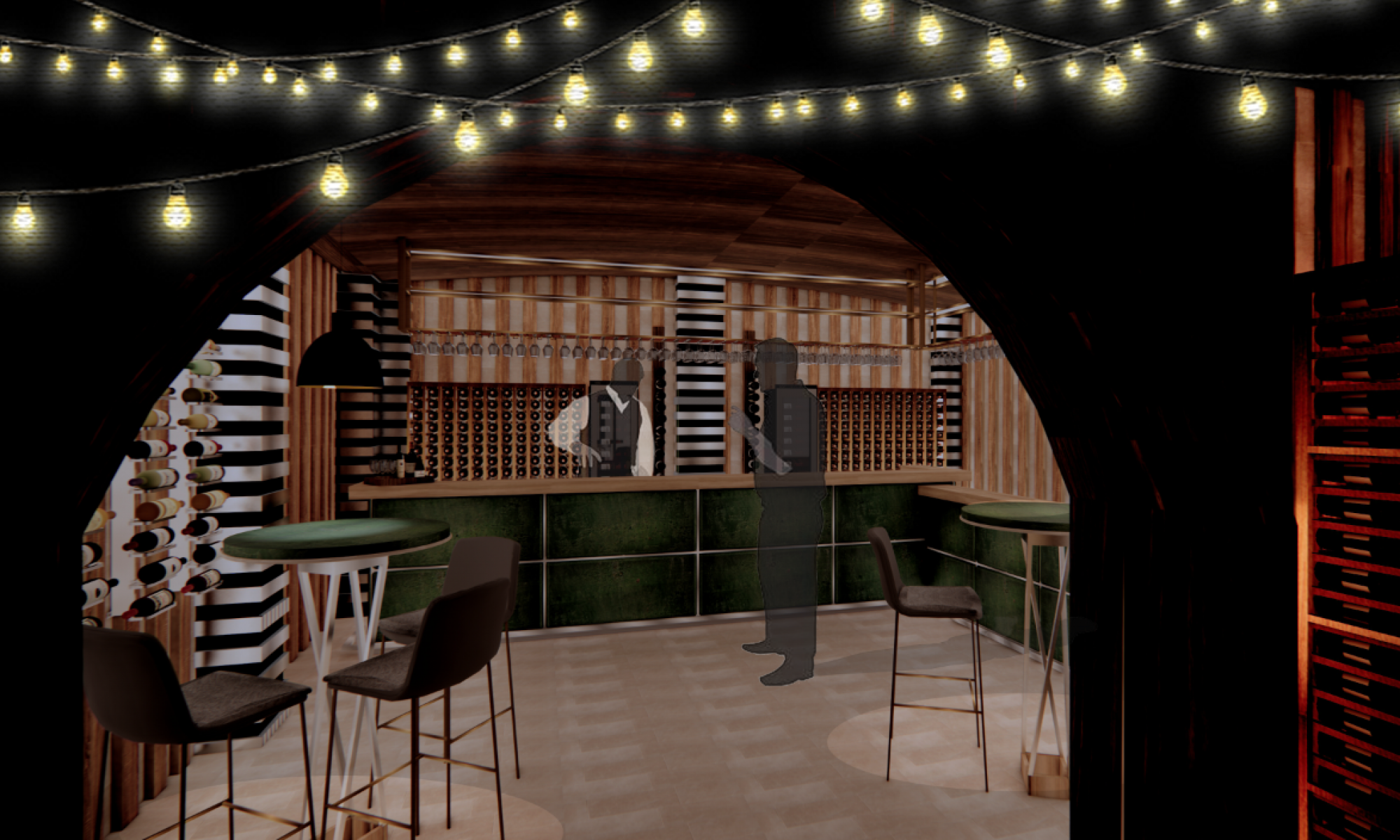
During the following weeks after the concept review, I focused on the wine ‘cave’, exploring textures, furniture and spatial circulation of the space. Initially, I experimented with the curves/arches which could be incorporated into the space. During this time I also experimented with furniture and the aesthetic of the space. I decided to incorporate the use of wine barrels as tables for the space, however after producing several conceptual visuals of what these might look like I found that they did not suit the space. Although I was still in the early stages of the design development, I was still unsure of how I wanted the space to look and after my barrel concept did not work out, I felt very lost. However, I then decided to explore all furniture options and experimented with different table heights. This allows the space to be filled with a variety of different lighting levels; ensuring the space is flooded with a variety of different shadows.

Changing the types of furniture used within the space and the different levels they were placed at made a huge difference to the aesthetic of the ‘cave’. This made me feel more confident to move forward with my design development. Once I had become more confident in my design progress with the bar space, I moved on to developing design ideas for the restaurant. As I mentioned In my previous blog post one of the main aesthetic features of the space was the wallpaper my granny chose for the original restaurant. I experimented with a variety of different materials such as wood and stone against the wallpaper and realised that due to its botanical features it perfectly blended in with the natural materials. My confidence has grown massively during this project and I believe that I have gained a better understanding of how to modernise vintage wallpaper to make them stand out in a contemporary setting. Whilst I wanted to make the wallpaper the main aesthetic of the space it was important to ensure that I did not overload the space and make it too busy. Therefore, to ensure this didn’t happen I complimented the wallpaper with natural features, this allowed the environment to stagger itself and become less overwhelming.

Alongside this, one of my main focuses was to ensure that I incorporated features from each unit into the others. The first thing I did during the design development process was to incorporate arch features from the wine cave space into CJ’s restaurant. As you can see from the images below the arched structures constructed out of wood in CJ’s restaurant links nicely with the wooden and stone arched formations featured in the wine bar. I have been incredibly inspired by the structural formations of caves throughout this whole project and this can be seen in the conceptual visuals I have produced during this section of the project.

CJ’s Restaurant – Arched wooden booths
CJ’s Wine BAR – Arched architectural walkways and features

EXPOSURE – CONCEPT REVIEW

CJ’s Restaurant and Wine bar

My final project for uni is called exposure. This project has enabled me to create my own brief and therefore, provided me with a lot of opportunities. This year has been full of highs and lows and has completely changed the way I view life. Unfortunately, I lost my Gramps during 2020 which affected me hugely mentally. To process my grief, I decided to use my Grandparents Restaurant and wine bar as my project brief. CJ’s was always spoken about during my upbringing and was a huge success during its time. The 1980s was a fantastic period for my Grandparents. They opened CJ’s Restaurant serving exceptional Cordon Bleu cooking as well as outstanding wine. CJ’s was situated in Newcastle Upon Tyne and was incredibly popular in its day. It resided in a Victorian House, spanning three floors. Like most buildings within the city, the original building was designed by architect Richard Grainger. I intend to redesign CJ’s Restaurant and wine bar, incorporating its original textures and aesthetics, whilst incorporating a contemporary and stylish twist.

Colin and Julia Davies outside the original CJ’s Restaurant

In 1995 my grandparents retired and moved to Dorset, closing CJ’s, and moving on. I intend to relocate CJ’s to Dorset, modernizing the interior design of the space, thus ensuring that those living in the Dorset area can appreciate the outstanding cooking and wine tasting that my grandparents were renowned for. I have chosen to relocate the space to Brewery Square in Dorchester, Dorset and is the main social hub for the Dorchester community.

LOCATION: 23 Weymouth Ave, Dorchester, Dorset, DT1 1QR

Brewery Square, Dorchester, Dorset

Two things that have driven this project is my Gramp’s concept of a ‘wine cave’ and my Granny’s obsession with a particular Sanderson wallpaper. These concrete ideas are the foundations of the space and will take centre stage in the aesthetic and structure of the design. Whilst the ‘cave’ is the main concept of this space I have struggled to incorporate this idea into a modern setting that does not have stone arched structures you would usually see in a cave. Although this was a struggle, I decided to use this idea and modernise it to make it suitable for the host building, including the use of darker tones and textures in materials such as wood, metal, and stone. To obtain the arched formation seen in cave structures, I started to draw curves that would be made from wood and/or metal. Due to my connection with my chosen brief, I was concerned that it would affect me emotionally, however, I hope that my passion and drive for this project will allow me to produce high-quality visuals of a space that is very important to me. I believe that during this critical stage of the project I have fully engaged with my chosen brief and explored every possible avenue which could be taken to make CJ’s come to life. If I had to complete this section of the project again in the future I would tell myself not to worry about producing an actual ‘cave’ but to use this concept and turn it into something unique and different based on my own perception of the word ‘cave’.

The original cave at CJ’s
The original Sanderson Wallpaper used within the Restaurant space at CJ’s (Vintage SUVA)

END OF PROJECT EVALUATION – ‘PERFORM’

EVALUATION:

My Final Major project for University has been extremely fun, but also very stressful. As a designer and creative person, I have loved the freedom this project has given me, and I believe that it has helped me develop my skills and designs which will inevitably help me become a successful interior designer.


All the projects I have undertaken at University have all had a strong concept behind them. This has allowed me to create a space that encompasses every aspect and detail of the performance. Aida is an opera which I loved as a child and my knowledge and love for this concept has enabled me to thoroughly enjoy the development of the design, and ensured that I was fully aware of the performance and what was required to make it come alive.
Although I have enjoyed this project, it has also had its downsides, and some of these were unexpected. As an interior design student, you need a good laptop to complete the course to a high standard as visuals are required to showcase your designs, concepts, and schemes. Alongside this, the current global crisis has caused a lot of problems for everyone, particularly students as our education has moved online which made it even more important to have access to the internet and a laptop. Unfortunately, my laptop decided to break during the most crucial development stage. This was incredibly unexpected and caused me to behind by one week for the development of the project. Although this was inconvenient, It has not stopped me from completing this project to the best of my ability and has shown me that even when bad things happen; you can always finish.


During this project, I believe I have fully engaged, attended, and committed to the brief and have taken the feedback given to me by my tutors positively and used them to develop my designs to a better standard and quality. The concept of ‘AIDA’ involves a large understanding of colour, texture and tone within spaces. Using colour within a space can help show emotions within different acts without having to remind the audience that this act is about ‘jealousy’ or ‘revenge’. (e.g., the textures and tones of the colour green symbolise jealous behaviour) My ability to understand the concept of ‘object, space and experience’, has been incredibly prevalent during this project. This is because I have had to focus hard on incorporating the main ideas and objects within a usual ‘AIDA’ set design and portray it in a modern setting.

Finally, this project has pushed me out of my comfort zone and encouraged me to challenge myself, which I believe is an important quality to have as a designer. The visuals I have created have been produced, to a high standard, and, I can see through my technical drawings that my artistic ability and creativity has developed over this year. Therefore, I believe that I have exceeded my potential and become a better interior designer.

PERFORMANCE SPACE VISUAL – created using a mixture of Enscape and collage techniques.
ROOF TOP BAR LOOKING OUT OVER THE PERFORMANCE SPACE VISUAL – created using a mixture of Enscape and collage techniques.
DOWNSTAIRS BAR SPACE VISUAL – created using a mixture of Enscape and collage techniques.
ROOF TOP BAR VISUAL – created using a mixture of Enscape and collage techniques.
PERFORMANCE SPACE DURING THE DAY VISUAL – created using a mixture of Enscape and collage techniques.

COMMUNICATION Review – ‘PERFORM’

COMMUNICATION REVIEW AND DEVELOPMENT:

Coronavirus has prevented a lot of things from happening and as a designer at University it has been incredibly hard, especially with the developmental process of my project. However, I decided to make the most of producing visuals of my project in the most fun way possible which personally was done through the means of collage. In previous years I have used software’s such as V-ray which is available on the Uni computers however, using Enscape and Photoshop to produce collaged based visuals was incredibly fun. My time at Cardiff Met has enabled me to become more confident using photoshop and I am happy with the results I obtain for my visuals.

BAR SPACE VISUAL

‘AIDA’ is an opera which incorporates bold, bright, rich, and vibrant colours, textures, and tones to its set design and often can look very overwhelming in a positive and fun way. As an interior designer I used these overwhelming colours to my advantage and produced a space which I believe captures AIDA and its concept. I produced a mixture of night and daytime visuals to allow viewers to gain a better understanding of how the space will look at both matinée and evening shows.

PERFORMANCE SPACE VISUAL

During my Communication reviews I was advised to ensure that I collaged in the surrounding environment to make the space more realistic. The feedback I obtained during this tutorial has enabled me to focus more on adding more detail to my final visuals which has helped them to become to an even better quality than what they were before. Although I managed to complete this part of the feedback I struggled initially as I found it hard to make the surrounding environment look real. To overcome this struggle, I decided to research into how to make the background collage look real on photoshop which was incredibly helpful and enabled me to develop my visuals further, making them a higher quality and standard.

During this stage of the project, I started to develop my final presentation which would show my design development from initial design ideas to final finished visuals. Completing these presentations shows me how my design has developed overtime and allows me to also pick out mistakes or things which need to be changed before my final submission.

This project has really enabled me to push myself out of my comfort zone and take risks with my project, and I believe that this has helped me develop as a designer.

DISPLAY AND KIDS CLUB SPACE

SCHEME review – ‘PERFORM’

SCHEME DEVELOPMENT:

Once I was certain with my chosen concept, I started to develop my designs further, but before I was able to start SketchUp development, I went to visit the host site which provided me with the additional knowledge. This helped me to understand the space available and the spacial movement and connections which can take place within it. Like I mentioned in my previous blog post I was unable to visit the site multiple times due to Covid-19 and the restrictions which were put in place.

One thing which surprised me from visiting the space was that the shipping containers were a lot smaller than I had initially anticipated. However, the host site space was relatively large which provided me with the opportunity to use a selection of shipping containers arranged in a variety of different ways.

My first instinct was to arrange the containers in a circular or semi-circle formation which would imitate the design of an amphitheatre which would perfectly portray the performance within the space. However, one disadvantage was that because the containers were rectangular in shape my ability to create a circular formation on the site with the audience still having the ability to see the performance was limited. From this I decided to create a modern twist on the shape of the performance space, incorporating containers stacked on top of each other to create different stages and producing a triangular layout which would link to the pyramid structures used within the ‘AIDA’ opera. Although the formation did not form the circular shape required for the amphitheatre, I decided to incorporate this in a different way with arched structures carved out of the left-over container material. By doing this I am encouraging shadows in the shape of arches to be displayed all around the site, giving the illusion of an amphitheatre structure.

The image above shows a sketch of my initial design for the space.

The process of researching my chosen performance and my ability to use its qualities to produce high standard designs has helped me develop as a designer. It also reassures me that I can be thrown into the deep end with a concept but still produce high quality visuals and design schemes for my clients. During the development process of this project, I have really enjoyed experimenting with the shipping containers within Sketchup as they can be placed in a variety of different positions which is incredibly exciting. Alongside this, I have developed my design quality and confidence within Sketchup which will inevitably help me in the future when I am given commissions to do for future clients. If I was to do this section of the design process again I would try to use software’s such as revit rather than sketchup to understand the way it works.

This image shows my Sketch-up development during the scheme stage of this project.

FINAL MAJOR PROJECT – ‘PERFORM’

CONCEPT:

This year’s major project was called “Perform”.

As a designer, the idea of creating a space which is used for performing arts is very exciting, this is because it provides lots of opportunities with the tones, textures, architectural formations, and installations which can be used within the space. We were given 3 different host buildings: The Boneyard, St Pauls church (Cardiff) and Stiwido Seligman. Initially, I was drawn to the church as the interior architecture had large arched formations which accentuated the stone textures used for the space; making it seem widely open and grand. However, after researching into all three host buildings I was incredibly excited about the Boneyards flexibility, sustainability, and creativity.

BONE YARD:

The performance I dedicated to this space came from a personal experience from when I was little. As a kid I went to see the Opera; Aida in the beautiful Aerona di verona. It was spectacular; my young mind was blown away by the bright, bold, and rich colours which accentuated and embraced the amphitheatre environment. I decided to use the flexibility and creativity of the shipping containers to create a modern amphitheatre which would act as a performance space for Aida. This concept has enabled me to develop as an interior designer as it has allowed me to explore further into amphitheatre design, forms, and textures as well as it’s interaction with the ancient Egyptian opera. Personally, I have always leaned towards the interior architecture side to this course, focusing on my ability to use the surrounding space and its architectural formations and blending them into the interior design of the environment. In this case I am incredibly interested in using the arched formations which are carved into the amphitheatre exterior as part of the main focal point within my final designs for this major project.

‘AIDA’ MOOD BOARD

This ‘PERFORM’ space must include a performance and bar space as well as a display space to showcase artefacts, designs etc. To continue with my ‘AIDA’ themed space, I intend to research further into the set design used within the performances and incorporate features, colours, textures, and tones into my own designs. Although the Boneyard provides me with great opportunities, their rectangular shape, materialistic properties, and hard exterior will mean I need to take into consideration the potential limitations/ problems I may face during this project. For example, the shipping containers are exposed to many insecticides and, therefore, their interior will need to be changed- thus meaning the original colour will have to be discarded.

The process of exploring the host site and developing a concept for my design was incredibly fun and exciting, however, if I was to do it again, I would investigate and survey the host site in more depth as this would have provided me with extended knowledge about the site. This would have provided me with more detailed opportunities and restrictions and analysis of the space. Due to Covid -19 it was hard to access the space and therefore, prevented me from doing this.

COMMUNICATION REVIEW

The communication stage of the design process is very important as it allows you to visualise your designs in a 3D setting. Sketchup and photoshop are the main ways to create life-like visuals to portray your design. At the start of my SketchUp development, I struggled to create the staircase which leads from the ground floor to the mezzanine floor. I have always struggled with the production of stairs in my projects however, after using YouTube I was able to develop new techniques which helped me when creating them in SketchUp. After speaking to Craig, he suggested that I should just focus on the ground floor and mezzanine for final submission and create 2 or 3 high-quality visuals which perfectly portray the function of the space and aesthetic. Alongside this, he told me to make the pods more defined to allow them to stand out from the space which is what I have been working on over the past couple of days. Due to the large amount of vegetation I have within my SketchUp model, I decided to experiment with post-digital rendering techniques which mike had recommended to me. I researched into the technique and I instantly fell in love with the artistic visuals that can be produced from the rendering. This technique uses photoshop to overlay shadows, lighting and vegetation to make the visual look realistic but also like an illustration. Experimenting with this rendering technique has allowed me to learn more about the photoshop software and how to change the brightness, contrast, lighting and saturation of images. I have become more confident using this software and I believe that my visuals have developed massively since the start of the year which I am incredibly happy about.
I believe that experimenting with this technique has helped me develop as an interior designer as it allows me to have a variety of different techniques to use when creating visuals for future clients and therefore, I can adapt the software I use depending on their needs and requirements.

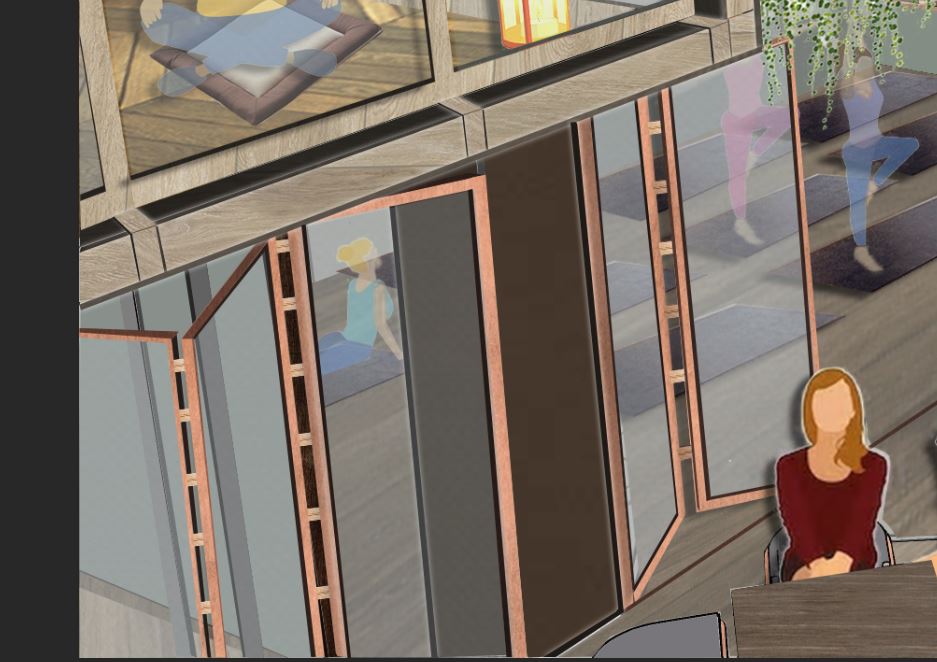
During the communication process, I had a one to one lecture with Craig on Micro tectonics. This as incredibly interesting and allowed me to understand how designs can be improved by additional detailing. As an a-level product designer, I understand how components of objects are assembled and dissembled which allows me to understand the importance of micro detailing. After speaking to Craig, he suggested that adding additional detailing to the screens/bi-folding doors will help improve the aesthetic of the visual as well as the accuracy. As you can see from the images below I have adapted the screens to become more realistic which improves the quality of the visual.

pic 5

screens

Design a site like this with WordPress.com
Get started